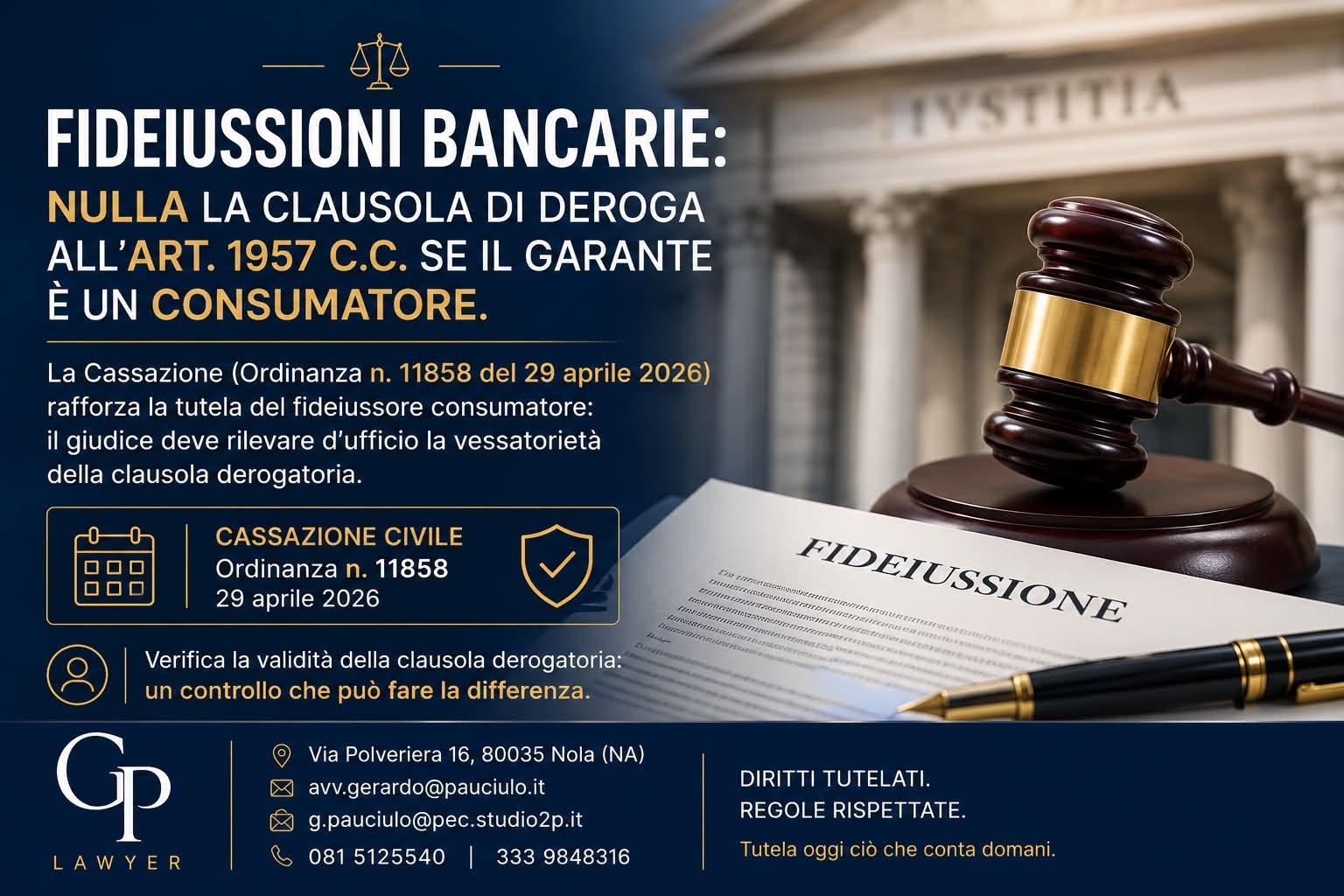
In Order No. 11858 of 29 April 2026, the Court of Cassation further strengthened protection of consumer guarantors, stating a principle with implications for banking litigation.
The Supreme Court held that a clause excluding or derogating, in the bank’s favour, from the Article 1957 time limit is unfair when the guarantor is a consumer.
Why is Article 1957 so important?
Article 1957 protects guarantors by requiring creditors to act within six months of the principal obligation falling due. If the creditor remains inactive beyond that period, the guarantee lapses.
The provision prevents indefinite exposure of guarantors to consequences of the principal debtor’s default. For many years banks included clauses eliminating or reducing this time constraint, enabling much later action against guarantors.
The principle stated by the Court of Cassation
According to the Court, exempting the bank from the six-month period creates a significant imbalance in contractual rights and obligations to the consumer’s detriment.
The consequences are particularly significant:
- the clause is void because it is unfair;
- the remainder of the guarantee remains in force;
- Article 1957 applies in full again, including its consequences for loss of the guarantee.
The court’s duty to examine nullity of its own motion
One significant aspect concerns the judge’s role. The Court specified that unfairness of the derogating clause must be examined even of the court’s own motion, without treating the issue as barred because the guarantor failed to raise it or raised it late.
This applies CJEU consumer-protection principles, requiring national courts to ensure effective review of unfair terms.
What are the practical consequences?
The order offers important defensive possibilities to guarantors who signed bank-drafted guarantees. It is particularly advisable to check:
- whether the guarantor qualifies as a consumer;
- whether the agreement waives or derogates from Article 1957;
- whether the bank actually complied with the statutory six-month period.
If these conditions are met, the bank may have lost the benefit of the guarantee.
Final observations
Order No. 11858/2026 confirms an approach ensuring effective review of terms unilaterally drafted by banks, including in guarantees.
The decision matters to practitioners in objections to payment orders, enforcement proceedings and guarantee litigation generally. Checking a clause derogating from Article 1957 is therefore among the first steps when enforcing a guarantee signed by a consumer.