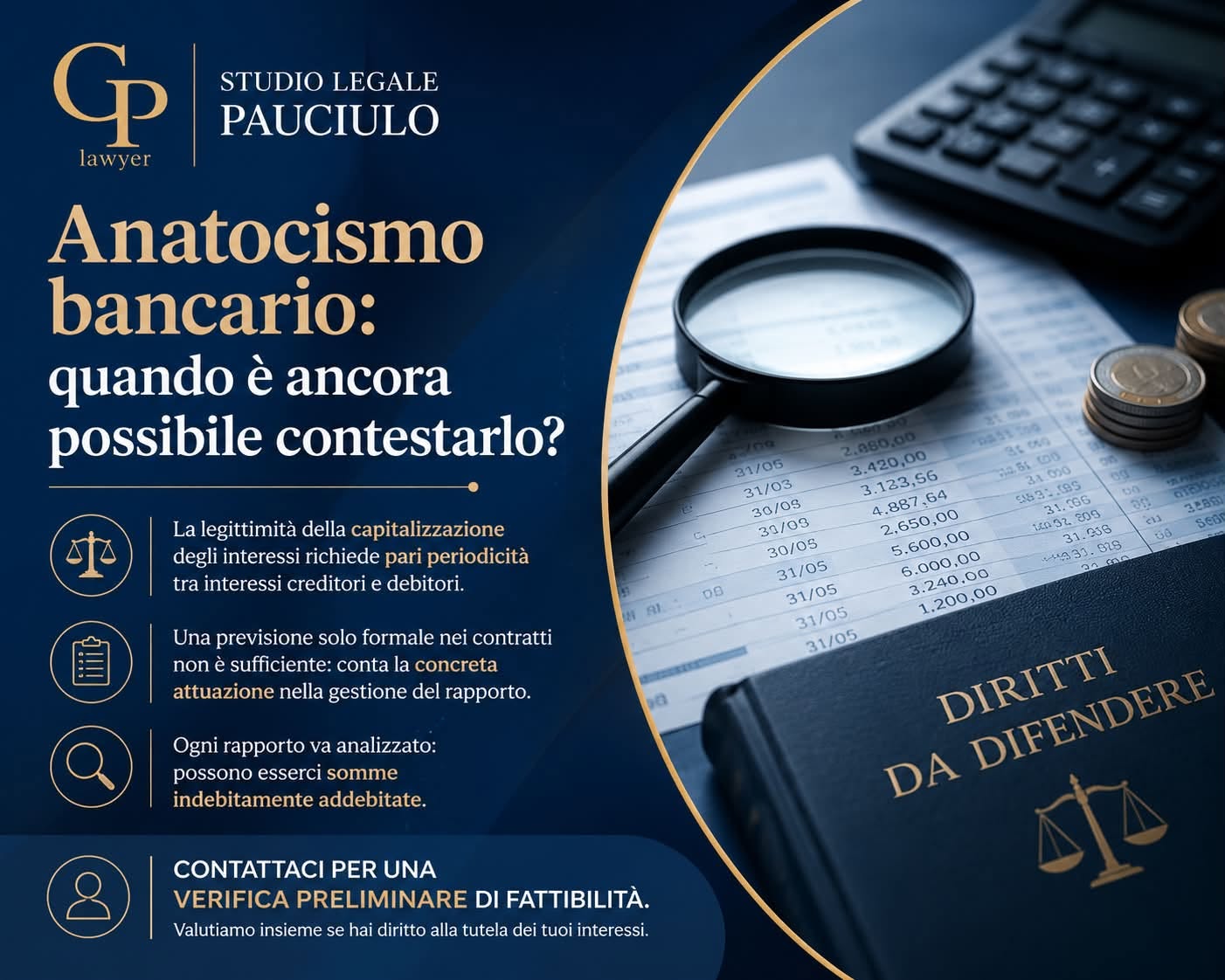
The view has spread that compound bank interest is a definitively settled issue. In fact, case law continues to confirm that, under certain conditions, the lawfulness of bank interest capitalisation may still be challenged.
A key issue is compliance with equal calculation frequency for credit and debit interest.
The equal-frequency requirement
For relationships governed by the CICR Resolution of 9 February 2000, lawful capitalisation required the same calculation frequency in each current account for interest accruing to the customer and interest owed to the bank.
A generic reference to the principle is insufficient. The clauses must be examined to establish whether the agreed mechanism actually ensures equal calculation frequency for both interest categories.
In Order No. 10775 of 22 April 2024, the Court of Cassation reiterated that valid intra-year capitalisation requires agreement on equal frequency and a correct effective annual rate incorporating capitalisation. Identical nominal and effective credit rates in that case meant the credit-interest clause had no practical implementation.
When a challenge may be well founded
Equal frequency may be merely formal where the actual contractual calculation mechanism produces non-reciprocal treatment. The clause may then be unlawful, affecting reconstruction of the balance and possible repayment of undue charges.
But a difference between debit and credit interest rates alone does not negate reciprocity. Order No. 11014 of 24 April 2024 clarified that different percentages are compatible with the requirement if calculation frequency is the same.
It is therefore wrong to assume either that every compound-interest challenge is barred or that every clause is automatically invalid. Each relationship requires examination of the contract date, agreed conditions, subsequent changes and statements.
A preliminary review can make a difference
Businesses, professionals and individuals with present or past current accounts, credit facilities or loans can check whether the applied interest conditions include unlawful provisions.
Studio Legale Pauciulo conducts a preliminary feasibility assessment to identify whether grounds for legal action exist.
A preliminary document review may clarify whether there are concrete prospects of recovering undue payments or asserting rights against the bank.