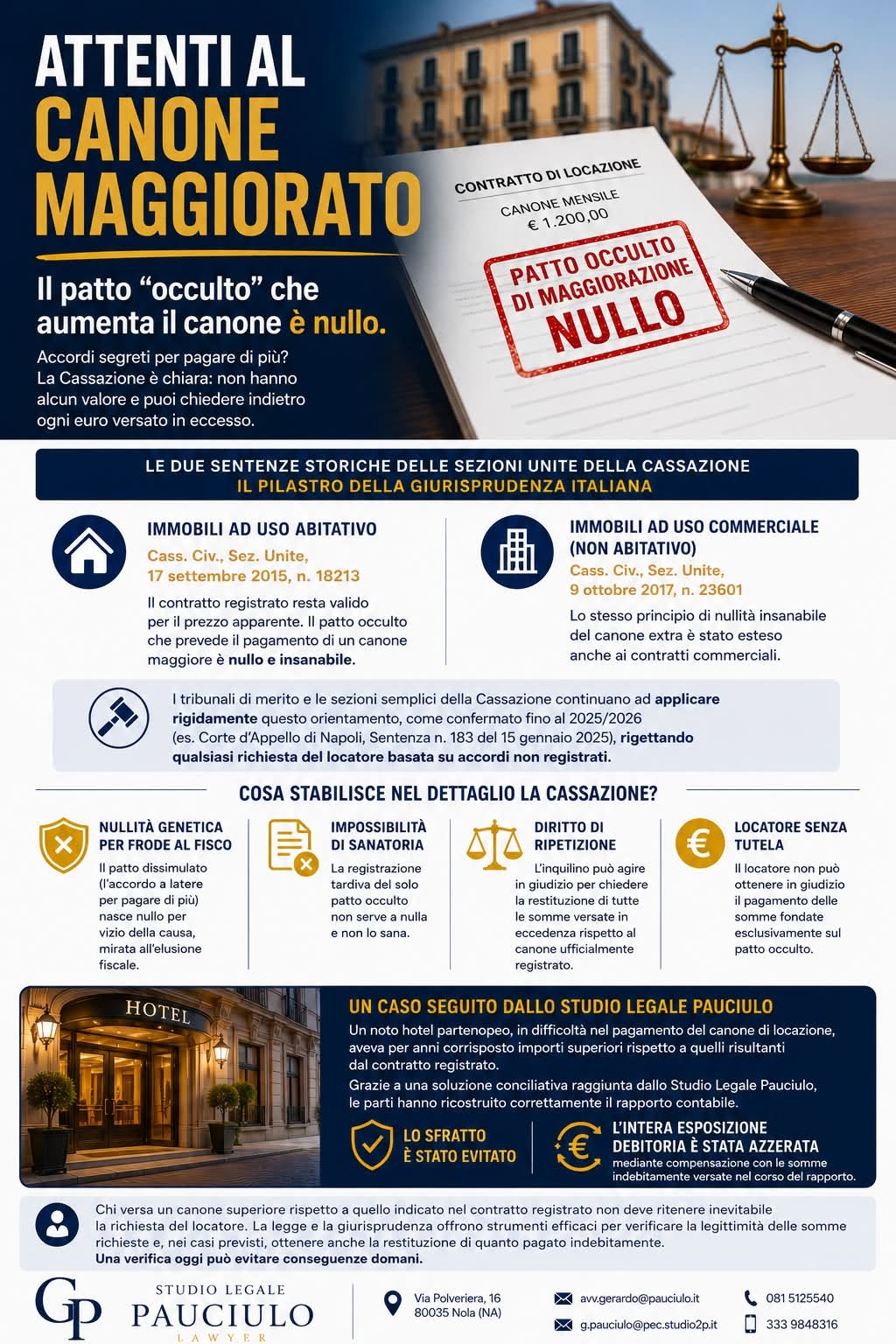
Alongside a registered lease, parties sometimes sign or implement a separate agreement requiring the tenant to pay rent above the officially declared amount.
The Court of Cassation’s Joint Divisions clarified that this concealed increase is void and cannot be cured by late registration.
Residential leases
In Judgment No. 18213 of 17 September 2015, the Joint Divisions held that, for residential leases, nullity under Article 13(1) of Italian Law No. 431/1998 affects only the concealed rent-increase agreement.
The registered contract remains valid, its stated rent remains due, and the concealed agreement requiring a higher amount remains incurably void.
The same principle for commercial property
Judgment No. 23601 of 9 October 2017 extended the principle to non-residential leases. A concealed agreement on rent above the declared amount is void for commercial premises too.
Nullity affects only the increase agreement, not the registered contract: the apparent rent remains payable. Late registration of the hidden agreement does not remove nullity.
What are the consequences of nullity?
Where the requirements are met, the tenant may challenge demands based solely on the hidden agreement and seek repayment of sums paid above the registered rent, subject to the limits and deadlines applicable to the case.
The landlord cannot base a claim for payment or termination solely on the concealed increase.
A case handled by Studio Legale Pauciulo
A well-known Neapolitan hotel experiencing difficulty paying rent had paid amounts above those in the registered lease for years.
Studio Legale Pauciulo examined the relationship and reconstructed payments. The dispute settled: set-off against amounts improperly paid during the relationship eliminated the debt and avoided eviction.
The outcome thus came not from a judicial ruling, but from a negotiated solution based on accurate reconstruction of the accounts and applicable principles.
A review can make a difference
Those paying above the registered rent should not regard the landlord’s demand as inevitable. The lease, any separate agreements and payment records should be examined to assess the sums’ lawfulness and available remedies.